
marcreichel/laya-php
Open on GitHub →
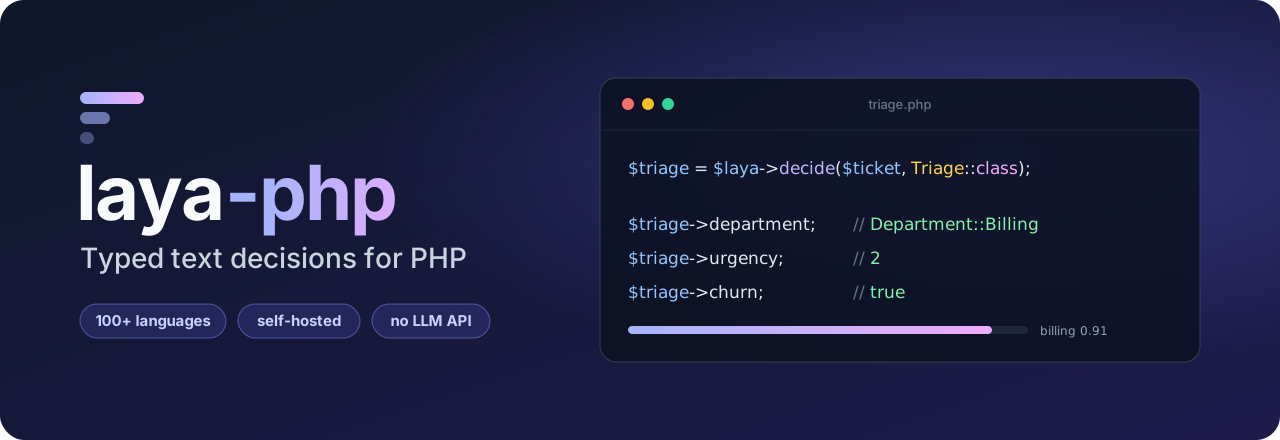
Classify text in PHP without paying for an LLM API. Route support tickets, spot churn risk and score urgency, in 100+ languages, on your own server, and get the answers back as typed enums, ints and bools.
$triage = $laya->decide('Hi, we were billed twice for March. Refund it today or we cancel.', Triage::class);

$triage->department; // Department::Billing
$triage->churn;      // true
- Self-hosted: the text never leaves your infrastructure, and you pay no per-token fees.
- Typed: describe a decision as a readonly class with enums and get an instance back.
- Calibrated: every answer has a confidence you can threshold on to send unsure cases to a human.
- Testable: a built-in fake lets you unit-test without a running server.
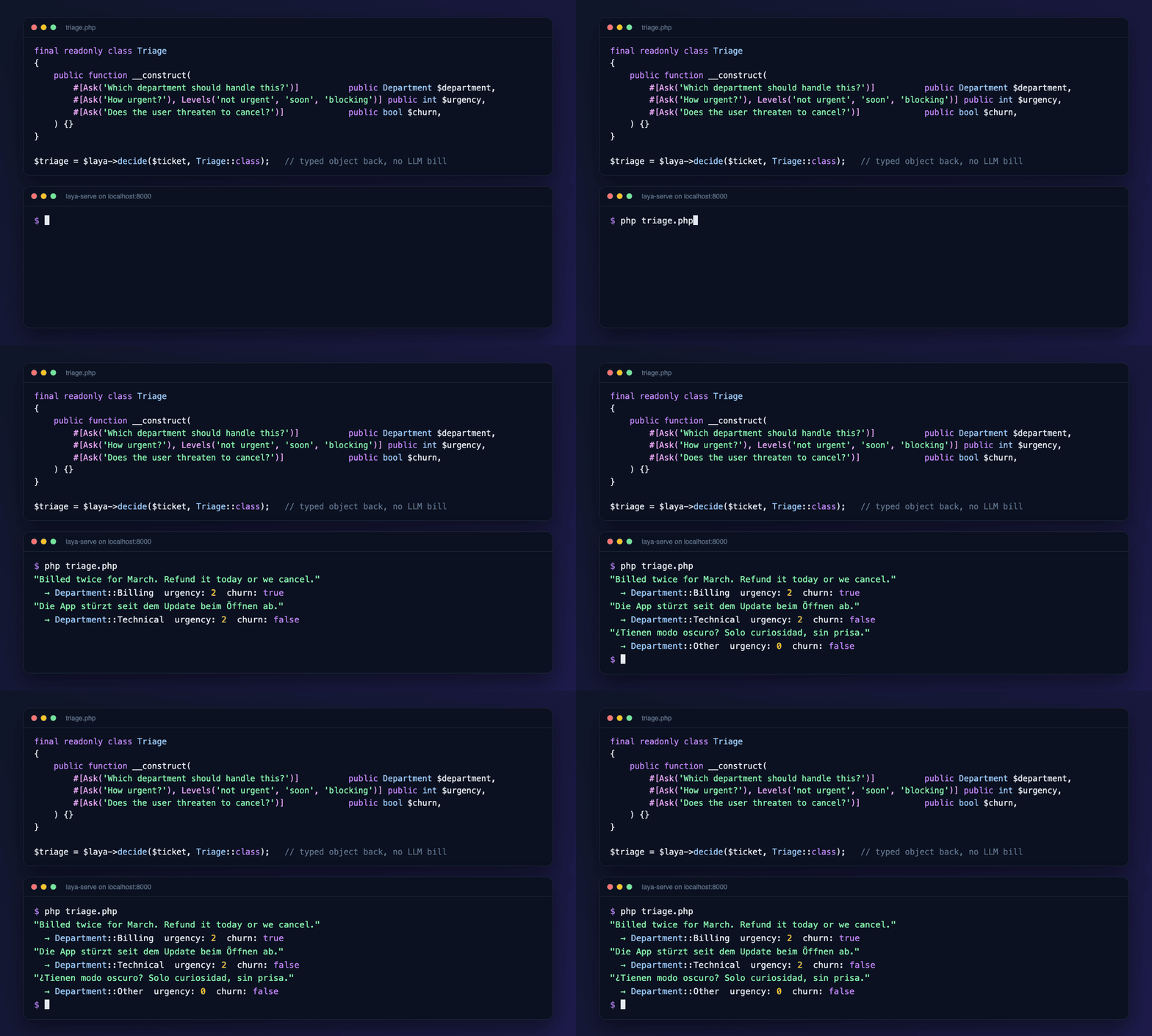
Under the hood this is an SDK for Laya, a multilingual decision engine that answers typed questions (choice, score, yes/no) about any text in a single forward pass. Laya runs in Python, so the SDK talks to laya-serve, Laya's HTTP server, over any PSR-18 client.
Looking for Jev? laya-serve speaks the same POST /v1/systemone protocol as TypeSafe's hosted Jev API, with the same choice/score/noul answers, so this package is also a self-hosted Jev AI alternative for PHP. It targets laya-serve and hasn't been tested against the hosted Jev API.
Installation
composer require marcreichel/laya-php
PHP 8.4+. You also need a PSR-18 HTTP client (Guzzle, Symfony HttpClient, …). The SDK finds the installed one automatically.
To run laya-serve locally, use the compose.yaml in this repository (it pins upstream Laya to commit d8a2e59) or follow Laya's Docker guide:
docker compose up -d --wait # http://localhost:8000
Runnable scripts are in examples/. Set LAYA_URL (and LAYA_API_KEY) if your server isn't on localhost:8000. 05-testing-with-fake.php runs without a server.
Laravel
For Laravel 13+, the service provider is auto-discovered. It registers Laya as a singleton, configured from your .env:
LAYA_URL=http://localhost:8000
LAYA_API_KEY=
LAYA_CACHE_STORE=   # e.g. redis, to cache predictions (see Caching)
LAYA_CACHE_TTL=     # seconds
php artisan laya:health prints the server's status and loaded checkpoints, and exits with 1 when it is unreachable or unhealthy, so you can use it in deploy checks.
Inject it wherever you need it:
use MarcReichel\Laya\Laya;

final class ClassifyTicket implements ShouldQueue
{
    use Queueable;

    public function __construct(public Ticket $ticket) {}

    public function handle(Laya $laya): void
    {
        $triage = $laya->decide($this->ticket->body, Triage::class);

        $this->ticket->update(['department' => $triage->department]);
    }
}
To change the config file, publish it with php artisan vendor:publish --tag=laya-config. In tests, Laya::fake([...]) also replaces the container's instance, so injected code gets the fake (see Testing your code):
$laya = Laya::fake(['department' => Department::Billing, 'urgency' => 2, 'churn' => true]);

ClassifyTicket::dispatchSync($ticket);

$laya->assertPredictedCount(1);
Asking questions
use MarcReichel\Laya\Laya;
use MarcReichel\Laya\Question;

$laya = new Laya('http://localhost:8000', apiKey: getenv('LAYA_API_KEY') ?: null);

$result = $laya->predict($ticketText, [
    'department' => Question::choice('Which department should handle this?', [
        'billing'   => 'invoices, payments, refunds',
        'technical' => 'bugs, outages, system errors',
        'other'     => 'everything else',
    ]),
    'urgency'    => Question::score('How urgent is this?', ['not urgent', 'soon', 'blocking']),
    'churn_risk' => Question::yesNo('Does the user threaten to cancel or leave?'),
]);

$result->choice('department')->choice;        // 'billing'
$result->choice('department')->probabilities; // ['billing' => 0.91, 'technical' => 0.06, 'other' => 0.03]
$result->score('urgency')->level();           // 2: the most likely level
$result->score('urgency')->label();           // 'blocking'
$result->score('urgency')->score;             // 1.74: the expected level
$result->yesNo('churn_risk')->yes();          // true
$result->yesNo('churn_risk')->probability;    // 0.83

$result['department'];  // ArrayAccess works too (returns the base Answer type)
$result->routedModel;   // 'english': the checkpoint laya picked
The three question types:
| Factory | Options | Answer |
|---|---|---|
Question::choice($instructions, $options) |
a list of labels, or label => description |
ChoiceAnswer: choice, probabilities, is($label) |
Question::score($instructions, $levels) |
level descriptions, lowest first | ScoreAnswer: score, level(), label(), probabilities, legend |
Question::yesNo($instructions, yes: …, no: …) |
optional descriptions of yes and no | YesNoAnswer: probability, yes($threshold = 0.5), no() |
Every answer also has confidence and answerConfidence. answerConfidence is the calibrated one and is comparable across question types, so use it to decide when to trust an answer:
if ($result->choice('department')->answerConfidence < 0.7) {
    $ticket->sendToHumanTriage();
}
State
state can be a string, an array (a JSON document, or a list of conversation turns), or any JsonSerializable, such as your own models:
$laya->predict(['subject' => $mail->subject, 'body' => $mail->body], $questions);
Picking a checkpoint
By default, laya's router picks a checkpoint by language. To pin one:
use MarcReichel\Laya\Model;

$laya->predict($text, $questions, model: Model::Multilingual);
Long documents
Laya cuts the state off at the checkpoint's default length (512 or 1,024 tokens). With laya-serve 0.3.21 or later you can raise it per request with maxLen, and give questions with many or long options more room with headMaxLen:
$laya->predict($contract, $questions, maxLen: 4096);
$laya->decide($ticket, Triage::class, headMaxLen: 384);
laya-serve caps both at LAYA_MAX_TOKEN_BUDGET (8,192 by default) and answers anything above it with a ValidationException.
From laya-serve 0.3.22, $result->truncated tells you whether the state was cut off, so you know when to raise maxLen:
$result = $laya->predict($contract, $questions);

if ($result->truncated) {
    $result = $laya->predict($contract, $questions, maxLen: 4096);
}
Batches (experimental)
predictMany() and decideMany() ask the same questions about many states, which laya-serve 0.3.22 and later answers in shared forward passes. Results keep the keys you pass in:
$results = $laya->predictMany($tickets->pluck('body', 'id')->all(), $questions);
$results[42]->choice('department');

$triages = $laya->decideMany($tickets->pluck('body', 'id')->all(), Triage::class, maxLen: 4096);
Cached states aren't sent again, and the rest go out in requests of at most 64 states. One state that laya-serve rejects fails the whole request, the same way predict() throws. maxLen and headMaxLen apply to every state in the batch and need laya-serve 0.3.23; older servers ignore them. A laya-serve older than 0.3.22 answers with a ServerException that names the version it needs.
Both methods are experimental and may change in a minor release.
Decisions into objects
Describe the decision as a class, and decide() asks its questions and gives you an instance back:
use MarcReichel\Laya\Attributes\Ask;
use MarcReichel\Laya\Attributes\Describe;
use MarcReichel\Laya\Attributes\Levels;

enum Department: string
{
    #[Describe('invoices, payments, refunds')]
    case Billing = 'billing';

    #[Describe('bugs, outages, system errors')]
    case Technical = 'technical';

    case Other = 'other';
}

final readonly class Triage
{
    public function __construct(
        #[Ask('Which department should handle this?')]
        public Department $department,

        #[Ask('How urgent is this?'), Levels('not urgent', 'soon', 'blocking')]
        public int $urgency,

        #[Ask('Does the user threaten to cancel or leave?')]
        public bool $churn,
    ) {}
}

$triage = $laya->decide($ticketText, Triage::class); // Triage
| Constructor parameter | Question | Value |
|---|---|---|
| backed enum | choice (case values are the options; #[Describe] adds descriptions) |
the most likely case |
bool |
yes/no | true when P(yes) ≥ 0.5 |
int with #[Levels(...)] |
score | the most likely level index |
Every parameter needs #[Ask]. Any other type throws an InvalidQuestionException that names the parameter.
#[Ask] takes a few options on top of the question:
final readonly class Triage
{
    public function __construct(
        // null when the calibrated confidence is below 0.7, so you can hand the ticket to a human
        #[Ask('Which department should handle this?', minConfidence: 0.7)]
        public ?Department $department,

        // bools can describe yes and no, and pick the P(yes) from which they are true
        #[Ask('Does the user threaten to cancel or leave?', yes: 'says they will cancel or switch', threshold: 0.3)]
        public bool $churn,
    ) {}
}

$triage = $laya->decide($ticketText, Triage::class);

if ($triage->department === null) {
    $ticket->sendToHumanTriage();
}
| Option | Applies to | Effect |
|---|---|---|
minConfidence |
any nullable parameter | null when answerConfidence is below it |
yes, no |
bool |
describe what yes and no mean |
threshold |
bool |
true when P(yes) ≥ threshold (default 0.5) |
For the full probabilities, use predict().
Recipes
Routing incoming email
Pass the email as a document and give unsure answers to a human. German, Spanish or Hindi emails work the same way, with no extra setup.
$result = $laya->predict([
    'from'    => $mail->from,
    'subject' => $mail->subject,
    'body'    => $mail->body,
], [
    'team' => Question::choice('Which team should answer this email?', [
        'sales'   => 'pricing, quotes, new contracts',
        'support' => 'problems using the product',
        'billing' => 'invoices, payments, refunds',
        'spam'    => 'newsletters, cold outreach, phishing',
    ]),
]);

$team = $result->choice('team');

$inbox->assign($mail, $team->answerConfidence >= 0.7 ? $team->choice : 'triage');
Moderating reviews
Hold abusive or spam reviews back before they are published, and record the sentiment while you're at it.
enum Sentiment: string
{
    case Positive = 'positive';
    case Neutral = 'neutral';
    case Negative = 'negative';
}

final readonly class Moderation
{
    public function __construct(
        #[Ask('Does the review contain insults, hate speech or threats?')]
        public bool $abusive,

        #[Ask('Is this spam or an advertisement rather than a real review?')]
        public bool $spam,

        #[Ask('What is the overall sentiment of the review?')]
        public Sentiment $sentiment,
    ) {}
}

$moderation = $laya->decide($review->body, Moderation::class);

if ($moderation->abusive || $moderation->spam) {
    $review->holdForModeration();
}
Scoring leads
A score question's score is the expected level, a float, so leads with the same most likely level still sort cleanly.
$result = $laya->predict($lead->message, [
    'intent' => Question::score('How ready is this person to buy?', [
        'just browsing',
        'researching options',
        'comparing vendors',
        'ready to buy',
    ]),
    'budget' => Question::yesNo('Does the message mention a budget, a timeline or a team size?'),
]);

$lead->score = $result->score('intent')->score; // 0.0 to 3.0
$lead->hot   = $result->score('intent')->level() === 3 && $result->yesNo('budget')->yes();
Finding relevant contract fields
Before you look anything up, find out which of a contract's fields a question needs. A yes/no question per field catches questions that touch several fields. One choice question over all fields is sharper when a single field is meant. Both go in the same request:
$fields = [
    'notice_period'  => 'how far in advance either side must give notice to end the contract',
    'auto_renewal'   => 'whether and for how long the contract renews automatically',
    'governing_law'  => 'which country\'s law applies',
    'jurisdiction'   => 'which court handles disputes',
    // ...
];

$questions = array_map(
    fn (string $description) => Question::yesNo("Do you need to know the contract's clause on {$description} to answer this question?"),
    $fields,
) + ['main_clause' => Question::choice('Which contract clause do you need to answer this question?', $fields)];

$result = $laya->predict('Who do we sue in if things go wrong, and under which law?', $questions);

$relevant = array_filter(array_keys($fields), fn (string $field) => $result->yesNo($field)->yes(threshold: 0.2));

if ($result->choice('main_clause')->answerConfidence >= 0.7) {
    $relevant[] = $result->choice('main_clause')->choice;
}

$relevant = array_unique($relevant); // ['governing_law', 'jurisdiction', ...]
Yes/no probabilities for this kind of question run low, so the threshold is 0.2 instead of 0.5. The full version with 20 fields is in examples/06-contract-fields.php.
Caching
Laya gives the same answer to the same input, so you can skip repeat requests with any PSR-16 cache. The key covers the state, the questions, the pinned model and the token budgets:
$laya = new Laya('http://laya:8000', cache: $psr16Cache, cacheTtl: 86400);
The key doesn't include the checkpoint revision, so clear the cache (or set a TTL) when you upgrade laya-serve's checkpoints.
Errors
Everything the SDK throws implements MarcReichel\Laya\Exceptions\LayaException.
| Exception | When |
|---|---|
InvalidQuestionException |
a question or decision class is malformed; thrown before any request is sent |
ValidationException |
laya rejected the request (400/413/422); the message names the problem |
AuthenticationException |
wrong or missing API key (401) |
ServerBusyException |
laya-serve is at its concurrency limit (503); safe to retry |
ServerException |
any other error status, or a response that isn't laya-shaped |
TransportException |
laya-serve couldn't be reached |
The SDK doesn't retry. For retries, pass an HTTP client that has them, such as Symfony's RetryableHttpClient or Guzzle with retry middleware:
use Symfony\Component\HttpClient\{HttpClient, Psr18Client, RetryableHttpClient};

$laya = new Laya('http://laya:8000', httpClient: new Psr18Client(new RetryableHttpClient(HttpClient::create())));
Testing your code
Laya::fake() returns a client that answers from values you register, with no server involved:
$laya = Laya::fake([
    'department' => Department::Billing, // or 'billing'
    'urgency'    => 2,                   // level index
    'churn'      => true,                // or a probability, e.g. 0.3
]);

// ... run the code under test with $laya ...

$laya->assertPredictedCount(1);
$laya->assertPredicted(fn ($state, array $questions, ?string $model) => str_contains($state, 'refund'));
$laya->assertNothingPredicted();
For decision classes, fake with an instance and assert on the class. A null answer (here or in the array form) is an unsure one: even probabilities and zero confidence, so minConfidence turns it into null again:
$laya = Laya::fake(new Triage(department: null, churn: true));

// ... run the code under test with $laya ...

$laya->assertDecided(Triage::class);
$laya->assertDecided(Triage::class, fn ($state, ?string $model) => str_contains($state, 'refund'));
If code asks a question you didn't register, or gives an answer that isn't one of the question's options, the fake throws.
Limitations
- One inference at a time.
laya-servehandles one request at a time, so parallel requests just wait in line. For many states, usepredictMany(), which shares forward passes. - Server limits.
laya-servecaps requests at 64 states per batch, 64 questions, 50,000 characters of state, 100 choice options, 32 score levels and 512 answer options in total.
Development
composer test           # Pest
composer test:coverage  # Pest with coverage (Xdebug or pcov), fails below 100%
composer test:mutate    # Pest mutation testing, fails below a 100% score
composer analyse        # PHPStan (max)
composer lint           # Pint

docker compose up -d --wait
LAYA_URL=http://localhost:8000 composer test:integration
License
Apache-2.0


